 Get new posts

Free 45-minute online sessions on setting a real AI challenge for a master's dissertation.
Book a briefingJoin the community for new pieces, the best of the discussion, and what is coming up.
Employers say graduates lack practical AI skills. Tutors are marking dissertations written badly with ChatGPT. Graduates face record competition for jobs. I think these are one problem, and the UK's 700,000 dissertations a year sit right in the middle of it.
Employers say graduates can't apply AI. Tutors say students are using ChatGPT to write dissertations, and doing it badly. Graduates are facing the task of competing with 140 other applicants for every graduate job. These three problems usually get discussed in three separate rooms. But maybe they're connected? And maybe one of the biggest untapped resources in UK higher education, the dissertation, is sitting right in the middle of them.
Employers say the skills aren't there. The government's AI Labour Market Survey 2025, carried out by Gardiner & Theobald for the Department for Science, Innovation and Technology, found that 97% of organisations have at least one AI skills gap. 88% rely on on-the-job training to fill it. Yet only 13% of graduate schemes include any AI training at all.
Tutors say students are outsourcing their thinking. HEPI's Student Generative AI Survey 2026 found that 94% of undergraduates use generative AI for assessed work. One student put the downside bluntly: "I'm not using my brain at all." When I talk to tutors, they usually aren't describing cheating. They're describing something duller: dissertations that are fluent, plausible and empty. The problem isn't that students use AI. It's that they use it badly, on their own, for a task AI can fake.
Graduates can't get noticed. The Institute of Student Employers found 141 applications for every graduate job, and 172 in London. And 92% of employers suspect or have confirmed that candidates use AI in their applications. Everyone looks the same on paper.
Students know all this. In the same HEPI survey, 68% said AI skills are essential, but only 48% felt their teaching staff were helping them build those skills for their careers. Students aren't asking to be protected from AI. They're asking to be taught to use it well, on something real.
These are surveys, so they carry the usual caveats. But they all point the same way.
Employers want proof that a graduate can apply AI to a real problem. Tutors want proof that a student did the thinking. Graduates need proof of something real that stands out in a pile of 141 applications. All three are asking for the same thing: evidence of real work, judged by people who know what good looks like.
For six years I was an employability adviser at the University of East London, mostly working with first-generation students. The ones who got on usually had something real to point to. Ruth Bridgstock's research found the same pattern: unless students already had connections through family or earlier careers, most weren't plugged into professional networks at all.
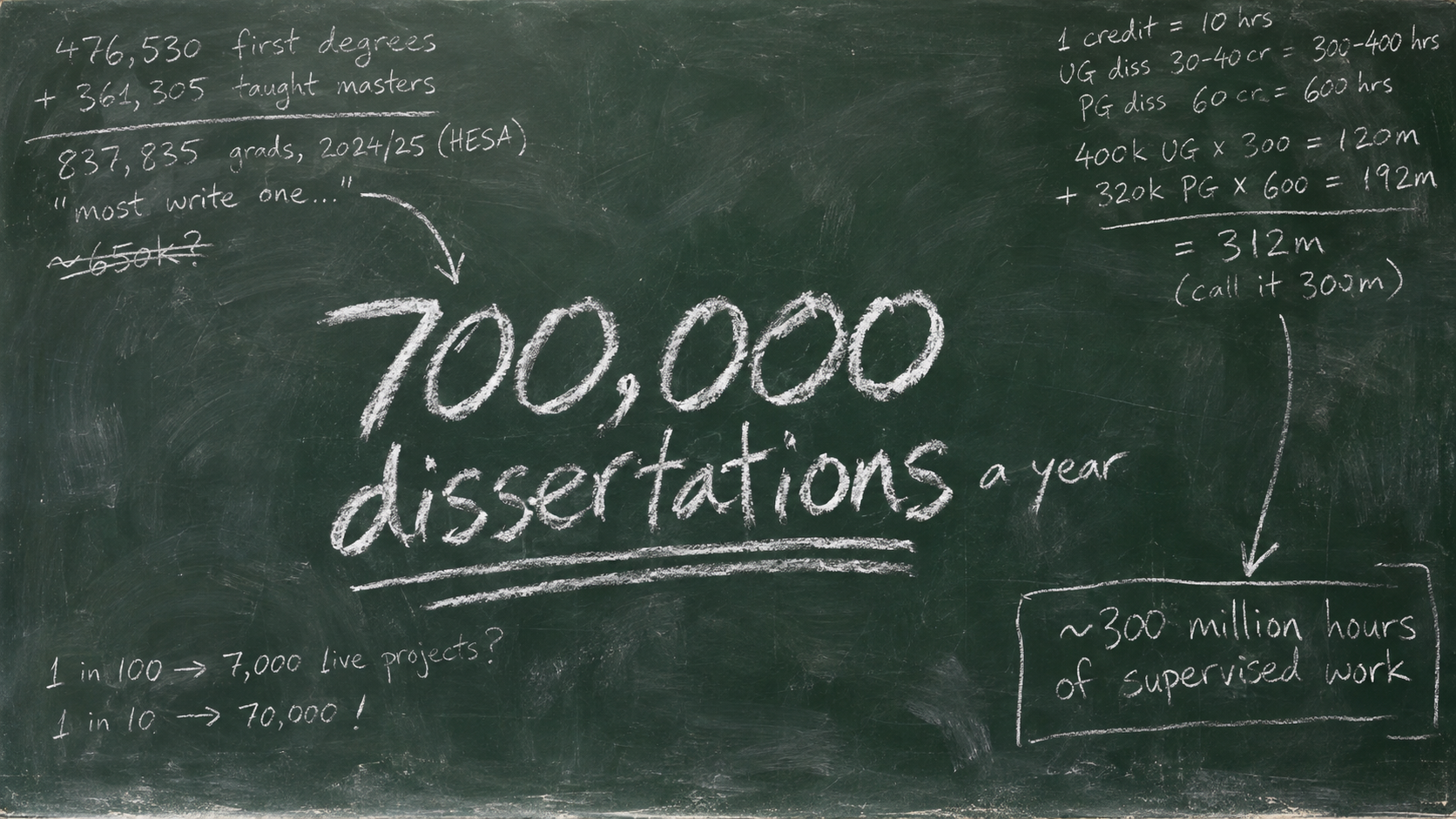
Nobody officially counts dissertations, so here's my estimate. In 2024/25, UK universities awarded 476,530 first degrees and 361,305 taught master's degrees (HESA). Most honours degrees and nearly all taught master's end in a dissertation or major project. That's roughly 700,000 dissertations a year.
One credit means about 10 hours of learning. An undergraduate dissertation is usually 30 or 40 credits, a master's dissertation 60, about 600 hours. Do the sum and you get something like 300 million hours of supervised, assessed independent work every year. That's about the full working year of 180,000 people.
Take just two subjects. In 2024/25, 28,455 students graduated with first degrees in engineering and technology, and 28,560 in computing. That's about 57,000 final-year projects, before you count a single master's student.
Most of that effort is read by a supervisor and a second marker, then filed. Some of it is brilliant. A lot of it answers questions nobody outside the university is asking.
Now imagine one in a hundred of those dissertations started from a real challenge set by a business, a charity or a public body. That's 7,000 live projects a year. At one in ten, it's 70,000.
None of this is new, and that's reassuring. More than a decade ago Mick Healey and colleagues argued for more flexible, equally rigorous final-year projects, including ones set with employers and communities. Silvia Gallagher and Timothy Savage reviewed 100 studies of challenge-based learning and found real benefits, but noted it's usually bolted on to courses rather than built into them. Thomas Corbin, Phillip Dawson and Danny Liu argue that in the age of AI, telling students the rules doesn't work: you have to change the structure of the assessment. And Jan McArthur reminds us the real world is bigger than the world of work.
Industry is saying something similar from the other side. The authors of the government's AI Labour Market Survey suggested aligning education more closely with industry needs. Agent Build Club sits in the middle of those two conversations.
This problem has many sides. The graduate jobs market depends on the economy and on hiring costs. Employers need to train, and 13% of graduate schemes teaching AI shows how far there is to go. Assessment design is for universities, not us.
But dissertations can be part of the answer, and they're already there. The time is in the timetable. The supervision is funded. The students have to do it anyway. We don't need new hours. We need to point some of the existing ones at real problems.
That's what the University of Surrey's AI Innovation Accelerator is set up to explore. It's funded by the Department for Science, Innovation and Technology through TechLocal, delivered by Innovate UK. Surrey leads it, and Agent Build Club is the partner bringing in businesses and running the community around it.
A business sets an AI challenge from its own work. A master's student scopes it, designs a solution, builds and tests a prototype with today's AI tools, and is assessed on it like any other dissertation. Because the project is the dissertation, it's built in, not bolted on.
Here's what matters most for the ChatGPT problem. The AI use isn't hidden. It's the thing being assessed. Which tool did you choose, and why? What did it cost? Where did it fail? What did a human have to check? That's very hard to fake in a viva with the business that set the challenge in the room.
We're starting with two courses: a dissertation option on Surrey's MSc in Electronic and Electrical Engineering, and a new master's in AI in Engineering. The first projects run from February to September 2027, and across three annual cohorts we aim for 25 to 40. That's tiny next to 700,000. It's meant to be. A pilot is for finding out what works.
Each project rests on an agreement between the university, the student and the business. Agent Build Club isn't a party to it and takes no part in marking. That lets us be an honest broker: on the side of the best outcome for all three, and focused on growth and innovation.
Then it turns again. The business that saw a good project comes back with two more. The graduate who gets hired brings the next challenge from the inside. Every turn makes the next one easier.
The internet gave students access to knowing. AI gives them access to doing. The dissertation was designed for a world of knowing. It can be redesigned for a world of doing.
If it works at Surrey, the route is clear: more courses, using a handbook and toolkit so course leaders don't start from scratch; then partner universities, starting with SETsquared; then beyond engineering. Law, design, business and health all have dissertations, and all have organisations with real questions.
Of course we'll sometimes be wrong about the solutions, but we'd rather learn that early, and always open to your interest, ideas and feedback.
Get in touch, or see what's on in our talks and briefings.