 Get new posts


Free 45-minute online sessions for engineering businesses curious about what AI could do for them.
Book a briefingJoin the community for new pieces, the best of the discussion, and what is coming up.
Innovate UK has funded the AI Innovation Accelerator, led by the University of Surrey, ranked 8th in the UK for developing AI talent, in collaboration with Agent Build Club. It's the first major project since founder Michael Kohn left Surrey and switched hats to start Agent Build Club.
Innovate UK has funded the London and South East AI Innovation Accelerator, led by the University of Surrey in collaboration with Agent Build Club. It's also the first major project for Agent Build Club since its founder, Michael Kohn, left Surrey this summer and switched hats to start it. Here's the news, why Surrey is the right place for it, and why Michael changed jobs to do this work. (For the longer story, Michael has written about why he started Agent Build Club.)
The London and South East: AI Innovation Accelerator for Professional Practice Projects, the AIIA for short, has been awarded a grant of £299,928 by Innovate UK. It runs for 30 months, from 1 August 2026 to 31 January 2029, and it's led by the University of Surrey in collaboration with Agent Build Club.
The AIIA turns real business challenges into business-led AI dissertations for engineering MSc students, supervised by University academics. Across three annual cohorts it aims to complete 25 to 40 of them, preparing graduates for AI jobs in engineering industries. The first cohort is under way now, and Cohort 1 dissertations run from February to September 2027. It's free for businesses to take part: we ask for a challenge and some time, not funding.
The University of Surrey was ranked 8th in the UK for developing the next generation of AI talent this month. The money.co.uk study assessed 146 UK universities on AI course provision, graduate outcomes and spinout activity. Surrey offers 11 AI-specific courses, one of the highest numbers in the analysis, and has 23 active spinouts in engineering, physical sciences and mathematics.
That ranking reflects a bigger commitment. From September 2026, Surrey has embedded AI in every degree, in ways specific to each subject, from foundation year to postgraduate. Civil engineering students, for example, use AI to generate and test structural design concepts, then check every output against their own calculations. When Universities UK published its Future Jobs Roadmap in September, it featured Surrey's approach as a model for the sector.
And Surrey keeps innovating. Alongside the AIIA, Surrey Business School is running its own Innovate UK-funded programme, the Southeast AI Skills Accelerator: B-Clinic for Business Transformation, where multidisciplinary student teams work with organisations on real AI challenges. The AIIA is the one focused on engineering. Both point the same way: graduates who can apply AI with judgement, and businesses that get practical help to adopt it.
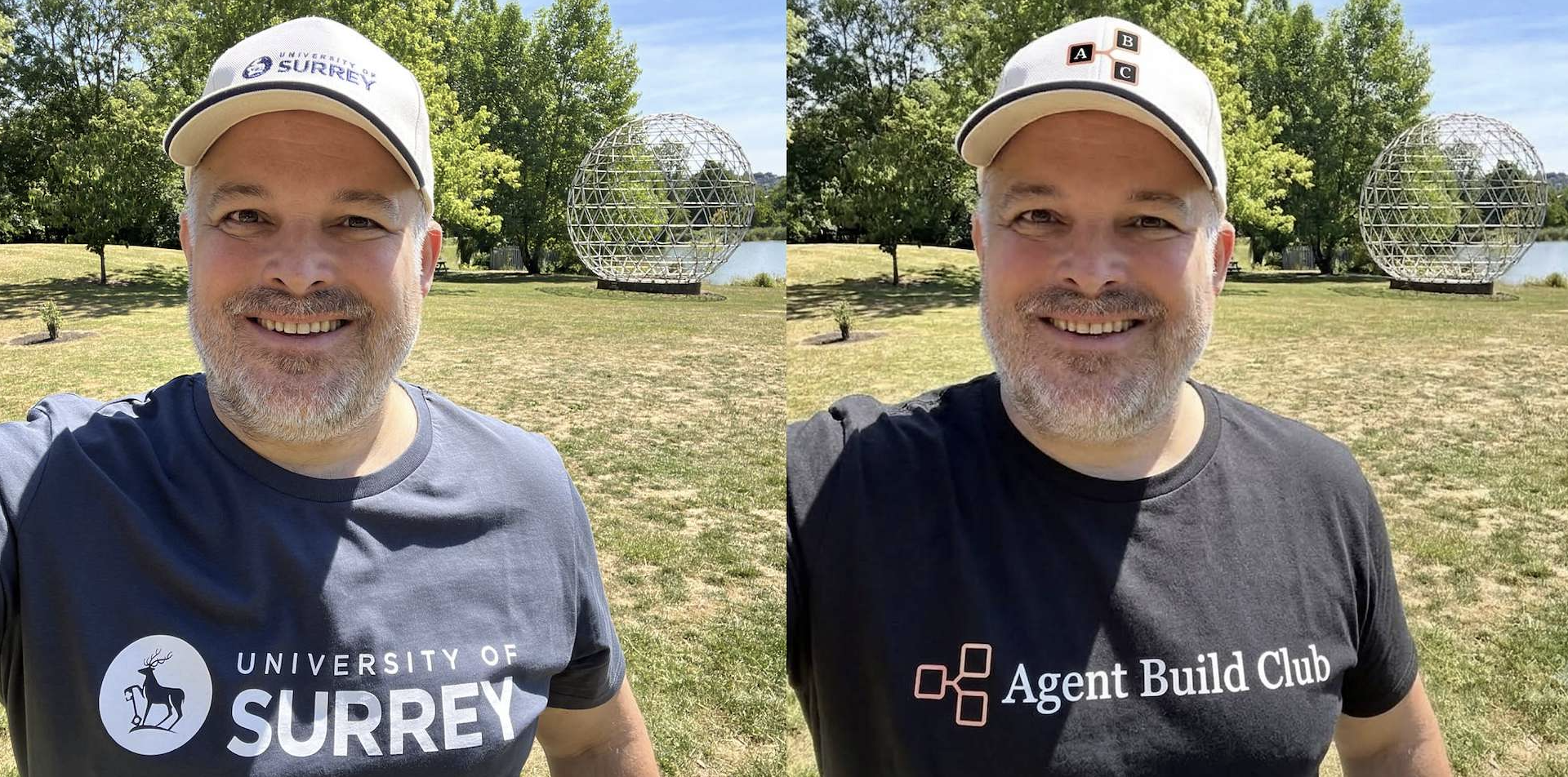
For four years, Michael Kohn worked at the University of Surrey as an innovation adviser. His job was helping academics turn research into impact: commercialising ideas, winning Innovate UK funding, building spinouts, and helping businesses find their way into collaborating with the University. It put him close to innovation across a very wide range of fields.
This summer he left to found Agent Build Club full time. In many ways the job hasn't changed. He's still working between universities and businesses, helping them collaborate on new ideas. What's changed is the employer, and the focus: applied AI, and how universities, businesses and learners can learn it together.
The AIIA builds directly on that experience. Through the collaboration, Agent Build Club engages engineering businesses across London and the South East, helps them shape AI challenges worth a student's time, and develops and delivers a free co-learning programme around the dissertations: the Future of Engineering (and Engineers) in the Age of AI talk series, a hackathon, an employability clinic and an online community. It has been a collaboration from the very first conversation, and Michael is back on campus, wearing a different hat.
The work that engineers and other professionals do is changing fast, and so is the way new ventures get started. The tedious early-career tasks people used to learn on are being absorbed by AI, which raises hard questions about how the next generation builds judgement. Michael has written about this in The ground is moving, on how AI is reshaping architecture, design and engineering; in Are we removing the first rung of the career ladder?; and in What would a just transition to the future of work actually involve?
Business-led AI dissertations are one practical answer. They fit inside a one-year MSc, so they can reach many more students than year-long placements, and one challenge can support more than one student.
If you run or work in an engineering business in London or the South East and you're curious what AI could do for you, join one of our free 45-minute online briefings. The dates are on our Luma calendar. Follow it to hear about every new session, including the free talks in our series on the future of engineering, and engineers, in the age of AI, open to businesses, students, graduates and educators.
You can also read more about bringing a challenge to the AI Innovation Accelerator.
Follow Agent Build Club on LinkedIn for news from the programme, and look out for our Field Notes, where we share the techniques Agent Build Club uses to run and build the business.
The AI Innovation Accelerator is funded by Innovate UK.